
On-Page SEO Services for Canadian Businesses
Mucha Marketing reviews your priority pages, maps each one to the search intent it should serve, and implements the agreed edits. The result is clearer, better-connected pages that searchers and Google can understand more easily.
Starting at $1,200 CAD per month
- Intent and URL mapping
- Agreed edits implemented
- Monthly report on agreed pages
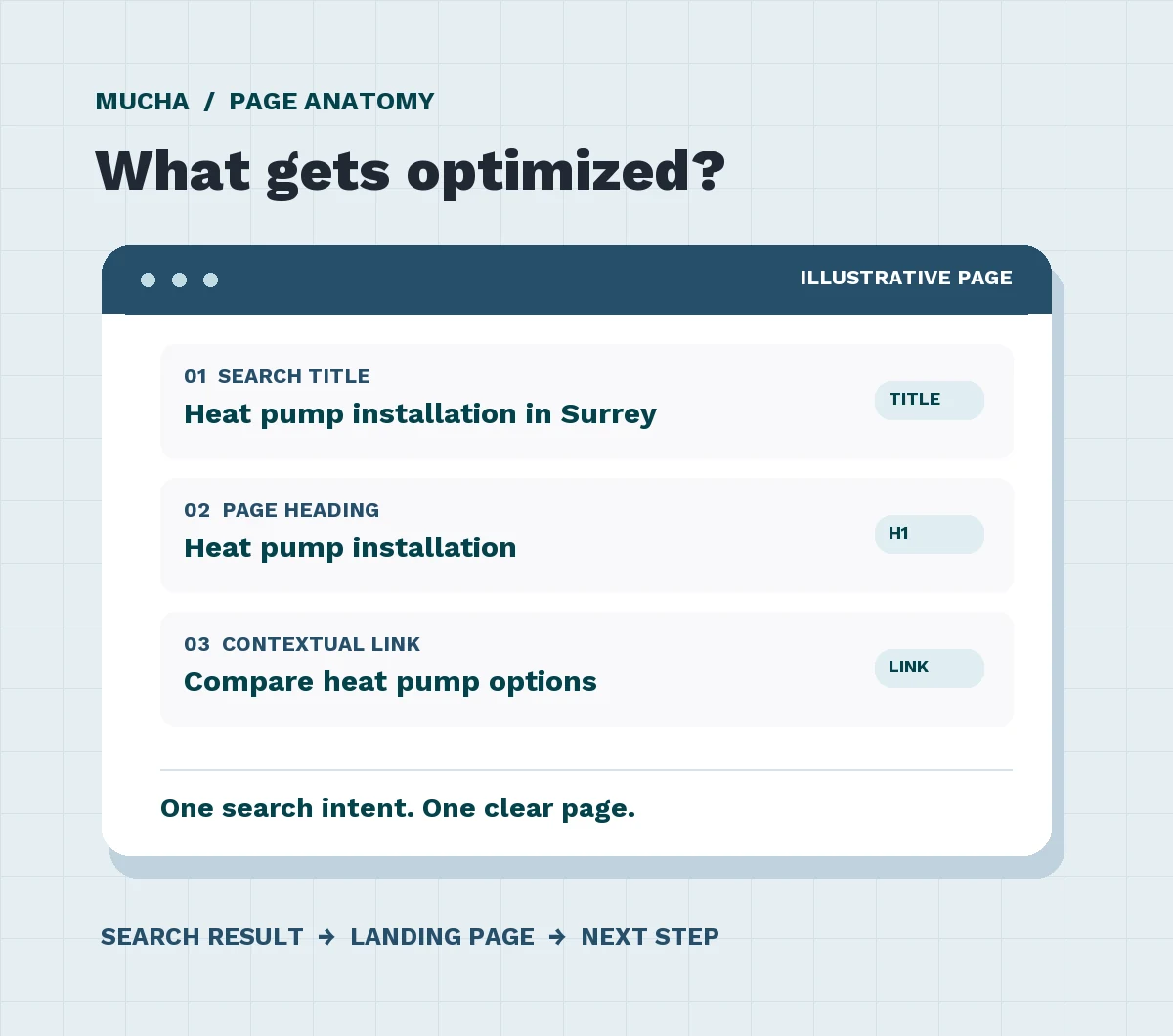
What does on-page SEO actually improve?
On-page SEO is the work done on the page itself. It covers what the page targets, how it is titled and structured, what it says, and how it links to the rest of your site. This service covers the pages agreed in your proposal. We audit those pages, decide what each one should rank for, make the approved edits, and report what changed. If we find technical issues along the way, we flag them for coordination. Large technical fixes are not part of this package.
- Clear intent match
- Each priority page should answer one main need, such as booking a service, comparing options or buying a product. When two pages chase the same query, both can struggle. We map queries to URLs so every page has a defined job.
- Accurate presentation in results
- Google builds title links from several sources, including your title tag and headings. It also often writes its own snippet from page text. We write titles, H1s and meta descriptions that agree with each other and with the content. Then we check what Google actually shows.
- Strong internal connections
- Pages with few internal links pointing to them are harder to find and can go unnoticed. Contextual links with descriptive anchor text help visitors and crawlers understand how your services, products and guides relate.
What we optimize on your pages
Here is what we review and improve on each agreed page.
Audit, intent and URL mapping
We start with Google Search Console data and a crawl of your existing site. Each priority page gets a main query group and a clear purpose. We flag overlap between pages. We also flag crawl, index, canonical and mobile Core Web Vitals concerns so you can coordinate them with your developer or a technical SEO project.
What you receive. Query-to-URL map with flagged issues
Title tags, H1s and heading hierarchy
Your title tag and H1 do different jobs. The title tag is a strong input for the title link in search results. The H1 tells a visitor they are in the right place. We align both, then fix heading order so H2s and H3s follow the real structure of the page.
What you receive. Revised titles, H1s and heading outlines
Meta descriptions and snippets
Google often writes its own snippet from page text, so a meta description is a suggestion, not a guarantee. We write descriptions that summarize the page accurately. We also make sure the opening copy works as a useful snippet. Then we check which text Google is actually displaying for key queries.
What you receive. Meta descriptions plus a snippet check log
Readability, depth and entities
There is no correct word count. A collection page needs different depth than a service page. We tighten unclear copy and answer the questions buyers ask before they call. We also name the useful entities a page should cover, such as service areas, equipment types, credentials you already hold or pricing factors.
What you receive. Content edits applied to agreed pages
Internal links and orphan risk
We add contextual links between related pages. The anchor text describes the destination instead of saying click here. We flag pages with few or no internal links as orphan risks. Navigation changes or sitewide template updates are noted for your approval before anything moves.
What you receive. Internal link changes and orphan risk list
URLs, images and structured data
We keep established URLs stable and recommend redirects when a URL needs to change. We improve meaningful image alt text and compress images where it helps. We use descriptive filenames for new images. Where it matches visible content, we add or correct supported structured data. Google decides whether to display a rich result.
What you receive. Image fixes and validated structured data
Related reading: Google’s SEO Starter Guide.See Technical SEO services for the broader scope.
See what an edit looks like
The example below is illustrative only. It uses Northbank Heating, a fictional heating and cooling company in Calgary. It is not an actual client or result. It shows the kind of edits we propose for different page types.
Illustrative examples. Select a row to explore it.
Service page: furnace repair
Product collection: smart thermostats
Established landing page: rebates guide
From page audit to published changes
- 01
Review priority pages
We review the pages agreed in your proposal along with available Search Console data.
- 02
Map and plan
We map queries to URLs and share the proposed edits for your approval.
- 03
Implement agreed edits
We make the approved changes on your site using access agreed in advance.
- 04
Report and plan next
Each month we report completed work, review the evidence and set the next priorities.
On-Page SEO Monthly Package
For businesses that want an agreed set of priority pages reviewed and improved each month.
Starting at
$1,200 CAD / month
First month
- Baseline audit of agreed pages with Search Console data and a query-to-URL map
- Priority edit plan covering titles, headings, content, links and images
- Implementation of the first approved page edits
Ongoing each month
- Report listing every edit completed on agreed pages
- Review of search data, displayed snippets and flagged issues
- Plan for the next set of pages or edits
The number of pages and edits depends on your proposal and your site. Large technical remediation, site migrations and link acquisition are outside this package and can be discussed separately.
How we report on your pages
| Signal | What it tells you |
|---|---|
| Impressions and clicks | Taken from Search Console for the mapped queries. They show visibility trends, but rankings and traffic also move with seasonality and competition. |
| Click-through rate | Shows how often searchers choose your result. It depends on the title link and snippet Google chooses to show, which we cannot fully control. |
| Displayed title and snippet | We record what Google shows for key queries. Results vary by device, location and query wording. |
| Index and link status | We track indexing, canonicals and internal link coverage for agreed pages. A page being indexed does not mean it will rank. |
Frequently asked questions
Do you just send recommendations, or do you make the changes?
We implement the agreed page edits. You approve the plan first. Then we make the changes on your site with the access you provide. If something falls outside the agreed scope, such as template or theme changes, we flag it and discuss it with you before any work begins.
How do you choose which pages to work on?
We weigh business priority against the available evidence. That includes Search Console impressions, pages close to earning more clicks, overlapping pages and orphan risks. Your proposal sets the pages in scope. Each monthly plan explains why each edit comes next.
How is this different from technical SEO or link building?
On-page SEO improves the content and structure of specific pages. Technical SEO covers sitewide issues like crawling, rendering, speed and migrations. Link acquisition earns links from other websites. We check and flag technical issues on agreed pages, but large remediation and outreach belong to separate projects.
Is there an ideal word count for each page?
No. A service page, a product collection and an established guide each need different depth. We aim for content that answers the buyer's questions clearly, covers useful details and reads easily on a phone. Length follows from those goals, not from a target number.
Can you guarantee first-page rankings?
No. Nobody outside Google controls how it ranks pages. We can show you the edits we made, the reasoning behind them and the measured signals that followed. That way you can judge progress on evidence rather than promises.
Get an On-Page SEO Proposal
Tell us which pages matter most and we will recommend where to start.

