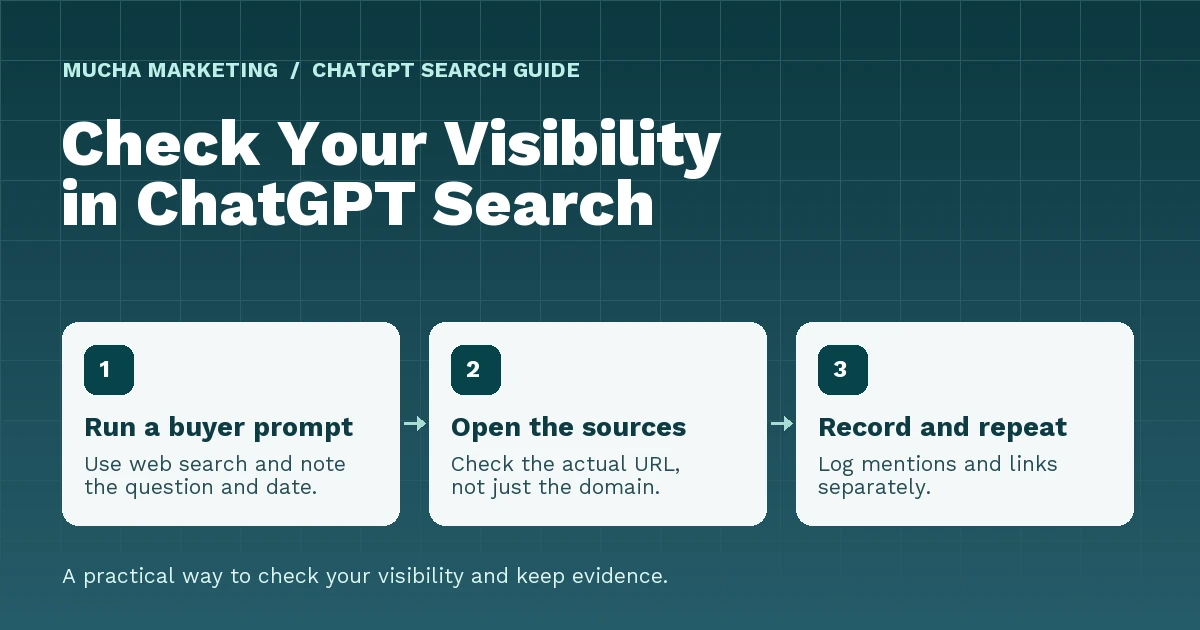
To see whether your business shows up in ChatGPT Search, run a realistic buyer prompt with web search turned on. Open the sources and log whether your brand is named, recommended or linked. There is no fixed position to rank for. Answers vary from run to run, so a single check is a snapshot, not a verdict.
Start here: a five-minute first check
Write down one question a buyer would ask before contacting you. Run it in ChatGPT with web search, then look at the linked sources. OpenAI’s help article on searching the web with ChatGPT explains how search answers show their sources. Record each of these four observations on its own:
- Brand mention: your name appears in the answer.
- Recommendation: the answer suggests you as an option.
- Citation: a source link points to your exact URL.
- Traffic: an identifiable referral shows up in your analytics.
A mention without a link is not a citation, and a citation does not guarantee a visit.
Step by step
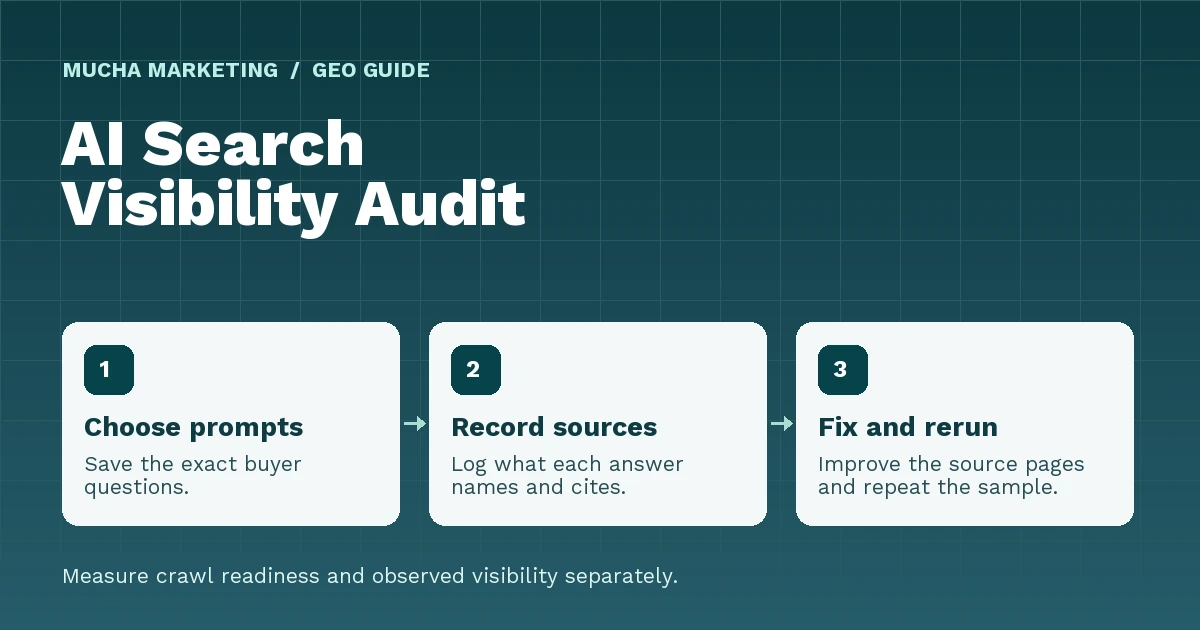
- Choose prompts: pick three to five buyer questions and save the exact wording.
- Run with web search: note the date and locale, and whether you were logged in, if you know.
- Open the sources: click each link and confirm the exact URL, not just the domain.
- Log: record mention, recommendation, citation and cited URL in separate columns.
- Repeat: rerun the same wording on a set schedule so you compare like with like.
Build source readiness
- Public pages: make sure each answer lives on a page anyone can load without signing in.
- Factual answers: state your services, area, CAD pricing and proof plainly.
- External references: check that your public business facts are accurate and look for relevant independent coverage. No source list guarantees a citation.
- Crawl access: OpenAI’s crawler documentation describes three separate agents. OAI-SearchBot crawls for search. GPTBot collects data for model training. ChatGPT-User makes requests that a user triggers. If you want your pages considered for search answers, check that robots.txt allows OAI-SearchBot. Blocking GPTBot is a separate decision. Being crawled is not the same as being shown.
Example prompt and evidence row
Illustrative sample: copy the prompt and fill in the row
Who offers [your service] in [your area], and what do they charge?
| Field | Example entry |
|---|---|
| Date | [YYYY-MM-DD] |
| Locale / logged in | [locale] / [yes, no or unknown] |
| Exact prompt | [paste wording] |
| Mentioned | [yes/no] |
| Recommended | [yes/no] |
| Cited URL | [URL or none] |
| Referral seen | [yes/no] |
Questions
How do you get a site recommended by ChatGPT and Claude?
No one can guarantee a recommendation. For ChatGPT, follow the steps above. Claude and other tools need their own checks; see AI search optimization services for cross-platform scope.
What’s a practical strategy for appearing in ChatGPT?
Start with real buyer prompts and record which URLs get cited. Then improve the pages that should answer those prompts, and rerun them.
What external sources help a website get cited?
Accurate public business facts and relevant independent coverage both help. Which sources get cited varies, and no fixed list guarantees a citation.
How can a small business get cited when competitors show up?
Run the same prompt and compare the cited domains. Note what evidence competitors provide, such as prices, service area or specifics. Then close the gaps that are true for your business.
Is using ChatGPT to do SEO the same as optimizing for ChatGPT Search?
No. A writing tool helps you produce content. Optimizing for ChatGPT Search means publishing accurate, accessible pages that can be found and cited as sources.
Next steps
For a repeatable check across many prompts, use the GEO audit guide. If you’d rather hand the work off, see ChatGPT SEO services.