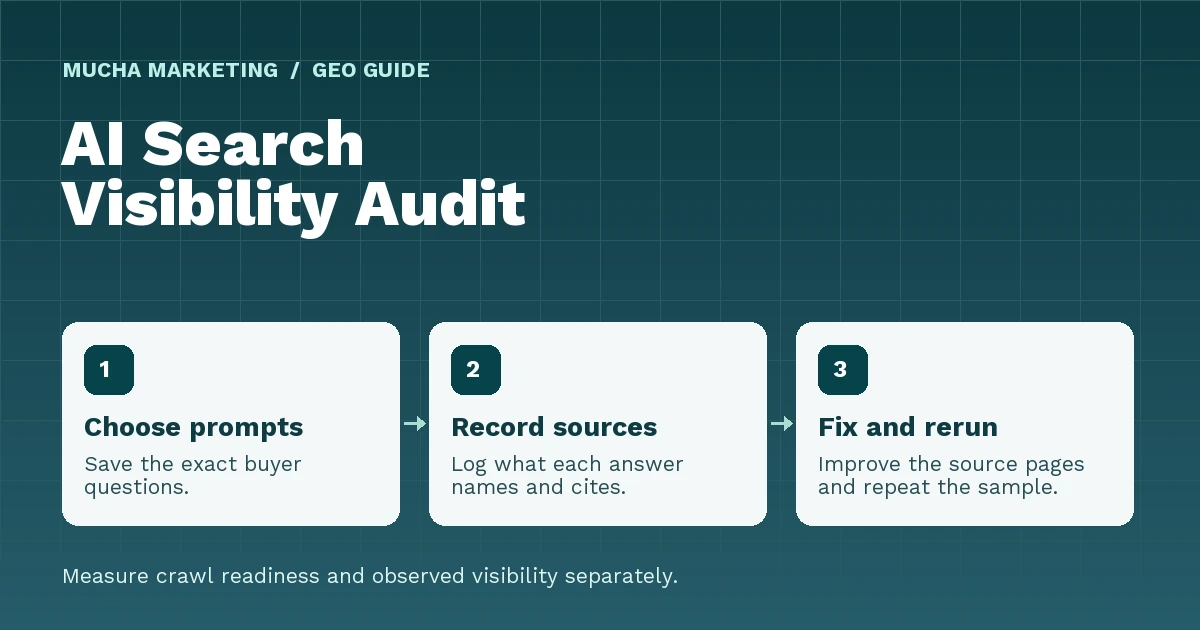
An AI search visibility audit compares two things. The first is what selected AI engines actually say or cite. The second is whether your key pages are accessible and answer the questions buyers ask. Start with a saved set of buyer prompts, run them, and record the source URLs.
A tool score alone cannot tell you why you are missing, which facts are wrong or whether a crawler is blocked. This method keeps the evidence you need to answer those questions.
Start an audit: build a prompt set
Group your prompts into cohorts so results stay comparable over time.
| Cohort | Example prompt | What it tests |
|---|---|---|
| Branded | “What does [business name] charge for monthly bookkeeping?” | Whether the facts about you are correct |
| Unbranded discovery | “Who offers small-business bookkeeping in the Fraser Valley?” | Whether you appear at all |
| Comparison | “[business name] vs [competitor]: which suits a sole proprietor?” | How you are positioned and which sources are used |
Run and capture
For each sample run, record the engine, date and time, search context and exact prompt, and save the exact output. Search context means locale and, where known, logged-in state. Record mention, citation and recommendation as separate flags. For each priority or cited URL, check three things: its public status, its robots rules and whether it renders. Add analytics referrals only when you can identify them, and keep them in their own column. Log every page change with its date so you can compare before and after.
Optional: copyable CSV header and illustrative row
date,engine,context,cohort,prompt,mentioned,cited,cited_url,recommended,notes
YYYY-MM-DD,[engine],[locale; logged in?],discovery,Who offers small-business bookkeeping in the Fraser Valley?,[yes/no],[yes/no],[URL],[yes/no],illustrative only
Score and interpret
Here is a hypothetical example. One discovery prompt is run 10 times on one engine. The business is mentioned in 4 runs and cited in 2. You would report this as 4/10 mentions and 2/10 cited runs, with the engine, dates and prompt.
- Always show the denominator: how many runs, on which engines, with which prompts.
- A prompt-set rate describes your sample only. It is not market share or a measure of model accuracy.
- When two reports disagree, compare their date, platform, exact prompt, search context and result limits before drawing conclusions.
- Small samples are uncertain. State the run count and avoid reading trends into one-run changes.
Triage: what to fix first
| Finding | Check | Fix first |
|---|---|---|
| Crawler problem | Error status, robots block or content that doesn’t render | Restore access. This blocks every other improvement. |
| Wrong facts | Which cited source or page carries the error | Correct the pages and listings you control, then rerun the branded prompts. |
| Missing citation | Whether a page directly answers the prompt, and what the cited sources provide | Improve that page’s answer and evidence. |
Questions
Do AI visibility trackers measure anything useful?
They give you samples. Ask which prompts, engines and run counts they cover, and confirm some results manually.
How do you audit a brand’s AI visibility in practice?
Build a prompt set across cohorts and repeat each run under recorded settings. Then check whether the facts in each answer are correct.
How do teams measure AI visibility, and which signals matter?
Use mention rate and citation rate, each reported with its denominator. Keep analytics referrals as a separate signal.
How can I find prompts where my website is cited?
Start from buyer questions, run them and record the exact cited URLs. Treat claims of complete, platform-wide prompt data with caution, and ask how the data was collected.
How should I track how often a brand is cited?
Rerun the same sample with the same settings on a schedule. Report changes with run counts and the uncertainty involved.
Next steps
- Check ChatGPT specifically with the ChatGPT Search guide.
- Fix crawl and rendering problems through technical SEO services.
- Want the audit done across agreed platforms? See AI search optimization services.